




| printer friendly | |||
|
|||
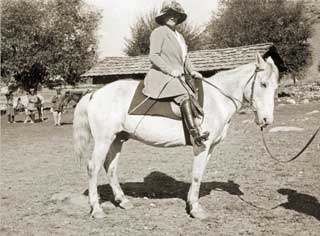 | |
| H. Roerich during the Central-Asian expedition |
From 1924 to 1928, Helena Roerich participated in a grandiose expedition organized by N. Roerich across the hardly approachable and little explored regions of Central Asia. She was the only woman who completed this extremely difficult itinerary. Helena Roerich shared all hardships and dangers of the way with the rest of the expedition members. Nicholas Roerich wrote, “To offer help, cheer up, explain something without sparing herself – Helena Roerich is ready for anything… Often you cannot help being amazed from where her energy comes, especially knowing her weak heart <…> On horseback together with us, Helena Roerich passed whole Asia, she was frozen and starved in Tibet, but she was always the first to show an example of vigor to the whole caravan. And the more was the danger, the more vigorous, ready, and cheerful she was. She had pulse 140, but she still tried to personally participate in the caravan arrangements and settlement of all the route concerns. Nobody ever saw her in depression or despair, though there were enough of all kinds of reasons for that”[6, p.162].
In 1926, in Mongolia (Ulan Bator), where the expedition found itself at that time, H. Roerich’s manuscript “Foundations of Buddhism” was published. That book interpreted fundamental philosophic notions of Buddha’s teaching, such as reincarnation, the laws of Karma, Nirvana and also discussed the deep underlying moral principles of such teachings, which refuted one of the main stereotypes of Western thought, which believed that in Buddhism man was worthless and as a creature forsaken by God.
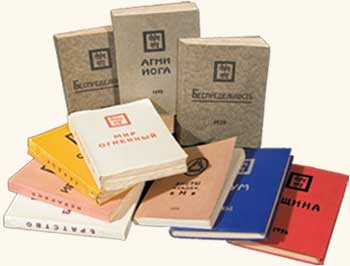 | |
| The Living Ethics Teaching Books |
In 1927, still there, in Mongolia, one of the Living Ethics book – “Community” was released.
In 1928, after their return from the Central-Asian expedition, the Roerichs settled down in the ancient and picturesque valley of Kullu in the Western Himalayas. There they founded the Himalayan Research Institute “Urusvati” (“The Morning Star”). H. Roerich was elected the honorable President of this unique scientific institution and took most active part in its activities-organization. Here in Kullu, Helena Roerich once again dedicated herself to the main work of her life – the books of the Living Ethics – and continued this work till the end of her life. As a philosophy of cosmic reality, the Living Ethics contains a unique system of cognition based on general and partial laws of the Cosmos, an integral part of which are Earth and mankind. This Living Ethics system of cognition corresponds to the new evolutionary turn in the development of mankind, when the perception of the cosmic world comes to substitute scientific thinking. The name of this very philosophy – the Living Ethics – unites man and Cosmos into a single spiritual system.
In 1929, in Paris, under the pseudonym J. Saint Hilaire, H. Roerich’s study “On Eastern Crossroads” was published. Those compositions (or apocrypha, i.e. texts which had not been included in canonic scriptures) convey information of legendary and historical events of days long past, tell about unknown sides of life of the Great Teachers of humanity – Buddha, Christ, Apollonius of Tian, Sergius of Radonega. To the image of Sergius, Protector and Defender of the Russian land, Helena Roerich dedicated a separate study, in which a perfect knowledge of history and theology was combined with a deep and reverent love for the ascetic.
Perfect mastery of foreign languages and deep knowledge of philosophy allowed H. Roerich to translate into Russian the “Secret Doctrine” – an outstanding work by Helena Blavatskaya, the founder of Theosophical Society, and selected letters of Mahatmas (“The Chalice of the East”). This allowed Russian-language readers to become acquainted with such important theosophical studies.
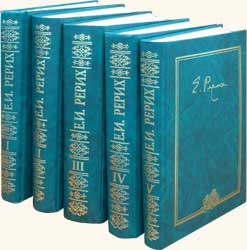 | |
| H. Roerich’s letters, published by the ICR |
A special place in Helena Roerich’s heritage occupy her letters to those who were studying the Living Ethics. If the Living Ethics teaching was created by Helena Roerich in collaboration with the Teachers, the “Letters” present a brilliant sample of her individual creative work. Gifted with an enlightener's talents, using simple and easily understandable language, she explained to her correspondents the most complicated issues of being. Including those concerning the place and role of man in the Universe, the laws of interaction between man and cosmos, and the peculiarities of relationship between spirit and matter. She gave real and practical advice. Reading those letters, one cannot help being amazed not only at her profound knowledge of ancient philosophical teachings, of the works of Oriental and European thinkers, but also at her broad and clear understanding of the foundations of existence. That is why H. Roerich’s “Letters” make necessary and integral part of the Living Ethics itself.
The two-volume edition of “Helena Roerich’s Letters” was first published in Riga in 1940, and has been many times reissued since then. At present Helena Roerich’s letters complete collection (Volumes I-IX) was published by the Manuscript Department of International Center of the Roerichs in 1999–2009. This publication includes part of a correspondence never published before, which enables us to appreciate in an absolutely new way this outstanding woman’s participation in the movement for the Banner of Peace related to Roerich’s Pact. One can say in all confidence that signing the Pact would have been impossible without Helena Roerich. It was Helena who, during N. Roerich’s Manchurian expedition (1934–1935), maintained all the business correspondence with the international cultural and educational organizations and coordinated their activities. The result of her dedicated work was the signing of Roerich’s Pact by the heads of twenty-two countries, including the USA, on April 15, 1935.
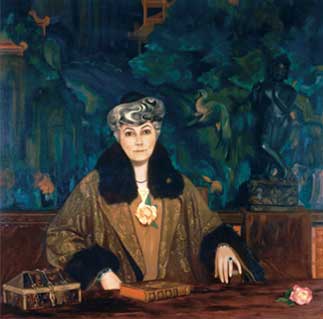 | |
| S. Roerich. Portrait of Helena Roerich. 1937 |
In January 1948, shortly after her husband’s death, Helena Roerich, together with Yuri Roerich, left the Kullu valley, and, after a short stay in Delhi and Khandala, settled in a little resort city of Kalimpong on the Eastern Himalayan slopes.
H. Roerich always yearned to come back to Russia. The applications concerning her return to the Motherland she submitted to the Soviet Embassy remained unanswered. The same happened to the letters and petitions addressed to the government. The Academy of Arts was equally unhelpful. But despite all refusals, Helena Roerich hoped to come back, to bring along all the treasures she had collected and to work at least for a few years for the Best Country – this is how she called Russia. Her hope to see Russia did not abandon her upuntil her very last days: “It cannot be that I should not come. I must come!” – she repeated just before her final departure[7, p.63]. But this return never happened. The country refused entry to her great daughter. On October 5th 1955, Helena Roerich passed away.
The more time passes, and the deeper we penetrate into the spiritual and philosophical heritage of the great Russian philosopher Helena Roerich, the more obvious becomes the greatness of what she has done for the evolution of the planet and for the whole mankind.
|
|
||
|
||

