




| printer friendly | |||
|
|||
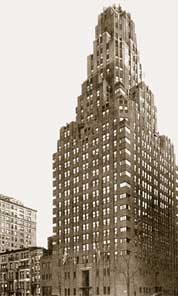 | |
| Nicholas Roerich Museum in New York.
1929 – 1938 |
N. Roerich belonged to the galaxy of those few thinkers of the 20th century who deeply understood the true significance of Culture and its crucial role in the development of mankind. “Culture rests on Beauty and Knowledge”[2, p. 60], he wrote, and repeated Dostoyevsky’s famous phrase with a little modification: “Comprehension of Beauty will save the world”[3, p.50]. This formulation covers practically the whole essence of cosmic evolution, which moves from chaos to order, from the simple to the complicated, from system to Beauty. Beauty is only cognized by man through Culture, integral part of which is creative work. This is also discussed in the Living Ethics books, in the creation of which the Roerichs took part directly. Helena Roerich put the Living Ethics’ cosmic ideas in writing and Nicholas Roerich perpetuated them in beautiful artistic images.
Putting into practice these ideas, N. Roerich conducted wide cultural and educational activities in America. In November of 1921, the Master Institute of United Arts was opened in New York, the main purpose of which was to bring peoples together through culture and art. Almost at the same time, artists association “Cor Ardens” (“Blazing Hearts”) was established in Chicago, and in 1922, the International Cultural Center “Corona Mundi” (“Crown of the World”) appeared. In 1923, the New York Nicholas Roerich Museum opened its doors. It contained the richest collection of the artist’s paintings. Institutions founded by Nicholas Roerich became major centers of culture in America, uniting many famous workers of art.
 | |
| N. Roerich. Kullu. 1930s |
After the expedition ended in July of 1928, N. Roerich founded the Institute of Himalayan Studies “Urusvati” that translates from Sanskrit as “The Light of the Morning Star”. In this very place, the Kullu Valley in the Western Himalayas, Nicholas Roerich and his family found their home. There, in India, the artist lived out the last period of life.
In 1934-1935, Nicholas Roerich headed an expedition to the areas of Inner Mongolia, Manchuria, and China, organized by the US Ministry of Agriculture with the purpose of studying drought resistant plants.
During N. Roerich’s expedition, the President of New York’s Nicholas Roerich Museum and N. Roerich’s authorized representative, the American businessman Louis Horch, falsified a series of documents and slandered his Teacher. He then illegally seized the Museum’s batch of shares and proclaimed himself its owner. He secretly removed the paintings and kept a part of them for himself. The vast majority of the canvases were sold at an auction and are still decorating private American collections. After some time, a group of museum workers devoted to the Roerichs obtained new premises for the Museum and acquired a considerable portion of the paintings.
|
|
||
|
||

