




| printer friendly | |||
|
|||
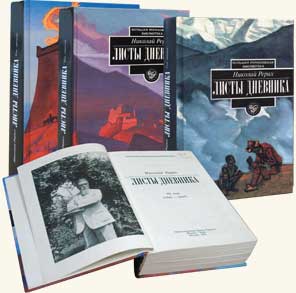 | |
| N. Roerich. Diary Pages.
ICR publication, 2002 |
N. Roerich included in the broad notion of Culture a synthesis of the best achievements of human spirit in the sphere of religious experience, science, art and education. It was Nicholas Roerich who for the first time formulated the concept of the essential difference of Culture from civilization. While Culture relates to the spiritual world of man in his creative self-expression, civilization is just the external arrangement of human life in all its material and civil aspects. The identification of civilization with Culture, Nicholas Roerich argued, leads to confusion between these two notions, as well as to underestimating the spiritual factor in the development of humanity. “Wealth in itself does not generate Culture. But broadened and subtler thinking and the sense of Beauty produce that subtlety, that nobility of spirit which are distinctive for a cultured person. It is this kind of person that can build radiant future for its country”[4, p. 49]. Proceeding from this, mankind must not only develop Culture, but is also obliged to protect it.
In the 1930-s, anticipating the threat of a forthcoming war, N. Roerich developed a project of a special Pact for the protection of cultural values in times of warfare and civil strife. Roerich’s Pact had a great educational significance. “A pact for protection of cultural treasures is not only needed as an official body, but as an educational law that, from the very first school days, will educate the young generation with noble ideas of preservation of the whole of mankind’s true values”[5, p. 82]. This cultural initiative was supported in the widest circles of the world community. The artist’s idea was welcomed by R. Rolland, B. Shаw, R. Tagorе, A. Einstein. The Pact was signed in the White House in Washington, on April 15th, 1935. At first, 21 countries of the American continent ratified the document. Subsequently, in 1954, Roerich’s Pact was placed at the very foundation of the Hague “International Convention for the Protection of Cultural Values in the Event of Armed Conflict.” N. Roerich also suggested a special flag, the Banner of Peace, that would mark all treasures of culture and art inviolable objects. To this day, the flag waves above many cultural and educational institutions all over the world.
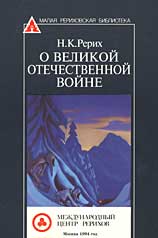 | |
| N. Roerich.
About the Great Patriotic War. ICR publication, 1994 |
In those years, formidable for Russia, the painter turned again to the subject of the native land in his creative work. In that period, he created a whole series of paintings – “Prince Igor”, “Alexander Nevsky”, “Guerrilla Fighters”, “Victory” – in which, using the images of the Russian history, he predicted the Russian people’s victory over fascism.
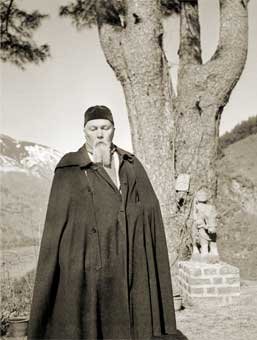 | |
| N. Roerich. Kullu. 1940s |
These calls were never abstract. Not only N. Roerich’s artistic and literary works were based on these principles, but so too his whole life. His contemporaries’ recollections, besides admiration for the versatility of his creative genius, convey the image of a purposeful man, who was striking by his extraordinary spiritual power, internal harmony, and extreme tolerance for other people’s views.
The fact that more than a hundred institutes, academies, scientific corporations and cultural institutions in the whole world have chosen him as their honorary and full member confirms the Russian painter’s worldwide recognition. The artist was treated with great respect in India itself as well: famous Indian philosophers, scientists, writers, public figures were personally acquainted with Nicholas Roerich. Many common Indians honored him as a great sage.
Recognition of N. Roerich’s services for public, scientific, and artistic activities in no way affected his attitude towards his Motherland. He always remained a patriot and a Russian citizen who only held one passport – Russian. N. Roerich never gave up the thought of coming back to his country. Right after the end of the war, the artist applied for a visa to enter the Soviet Union. But his intentions were not to be realized – in the full swing of preparations, on December 13, 1947, he passed away, without knowing that he had been denied his visa…
On the spot of his funeral pyre, facing magnificent snowy peaks, a big rectangular stone was installed on which the following inscription was carved: “Here, on December 15th, 1947, the body of Maharishi Nicholas Roerich – a great Russian friend of India – was committed to fire. Let there be peace”.
|
|
||
|
||

