



 |
| printer friendly | |||
|
|||
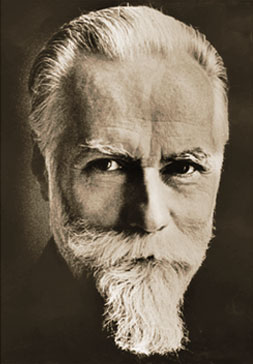
Svetoslav Nikolayevich Roerich (1904 - 1993)
“What we notice in Svetoslav’s paintings is the harmonious intensity of all parts of the painting. If indifference has not crept into works of art, then their quality is truly great. <…> It is wonderful if this high gift is given in life, due to it, all the dark, all the miserable turns into the joyfulness of spirit. And how happily we must welcome those who by the will of fate can bring the beautiful into life!”[1, p.443-444]
N. Roerich
Svetoslav Roerich was born on October 23, 1904 in Saint-Petersburg (Russia) and the first twelve years of his life he lived there. In his early childhood, the boy was already showing an interest for the natural sciences and this was harmoniously interwoven with inborn artistic abilities.
“I was very interested in ornithology, zoology,” Svetoslav Roerich recollected. “Helena Roerich acquired for me all the necessary books she could find. She bought us stuffed birds, raised collections of insects, bugs. Besides, I was attracted to beautiful stones, mineralogy. She also collected for me all kinds of stones from the Urals and other types. <…> Thus, our little world was at that time saturated with wonderful impressions” [2, p.54]. Svetoslav started drawing at an early age and took up molding, attended classes of the Arts Encouragement Society School, created designs for home theatre settings, and even helped his father in his work on theatre design sketches. In 1913, he entered the Karl May Gymnasium in Saint-Petersburg where he studied until 1916.
Svetoslav Roerich started his studies in architecture in London, at the Royal Academy of Arts, in 1919. After a year, he continued his education in the USA, first at Columbia University and then at Harvard University. He simultaneously attended the Massachusetts University Sculpture Department.
While in America, Svetoslav Roerich took most active part in the work of each cultural and educational institutions established by Nicholas and Helena Roerich. At the age of 19, he headed the International Artistic Center “Corona Mundi”, and later became the Vice-President of the New York Nicholas Roerich Museum.
In 1923, Svetoslav Roerich visited India for the first time. There he became acquainted with the most famous architectural masterpieces of Indian culture, as well as with the ancient and modern art of that country. In India, he laid the foundations of his unique collection of Oriental works of art that, unfortunately, went almost completely lost after his death.
|
|
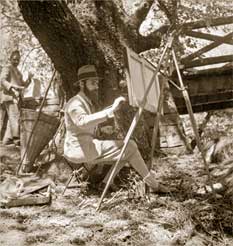
| S. Roerich. Naggar. 1937 |
|
In 1924, Svetoslav Roerich returned to the US and took active part in the managerial work of the cultural and educational institutions associated with Nicholas Roerich. It is exactly due to Svetoslav Roerich that his parents and elder brother - who were at that time on the route of the most difficult Central Asian expedition - kept in touch with the “external world.” This opened up for them possibilities for their fruitful scientific and research activities during the expedition. At the same time, Svetoslav Roerich continued to improve his drawing skills and worked constantly. In 1925, he received the highest award during an exhibition in Philadelphia, where nearly a hundred of his paintings were exhibited. The young painter’s subsequent achievements became his confident steps on the way to mastery and perfection.
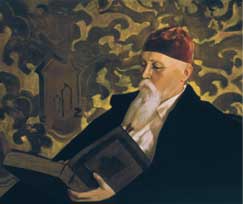
Svetoslav Roerich started his vocation of a painter as a portraitist, and reached highest mastery in this genre. A distinctive feature of his creative work was his desire to perceive deeply the character of the person whose portrait he was painting. Svetoslav Roerich pointed out: “We must always remember that a successful portrait is more than just resemblance.” The canvases created by his brush are elegant, laconic, and amazingly precise in conveying the spiritual and emotional image of the person portrayed. That is the reason for the fact that the images of people captured in these paintings look so alive and attractive. He painted about 30 single portraits of his father. One of them was purchased by the Luxemburg Museum in Paris. At that time, Svetoslav Roerich was just 35 years old. The gallery of portraits created by Svetoslav Roerich is enormous; the precious images of his parents are especially noticeable.
|
|
|
|
|
S. Roerich. Portrait of N.К. Roerich. 1934 |
Many features of the artist’s paintings testify to the influence of his father’s creative work. As Svetoslav Roerich noted himself "<...> the sources of my art are inseparably connected with N[icholas] R[oerich].” [3, p.49] At the same time, while continuing the art traditions of his great father, Svetoslav Roerich went his own way. In his works of art, there is no hint of imitation. Both painters - father and son - had their own unique style and technique.
Even in the event of a brief encounter with Svetoslav Roerich’s paintings, one feels the artist’s enormous creative range: in addition to portraits, he created with ease landscapes, epic, genre, and symbolic paintings. In all of these he showed himself as a virtuoso master and inspired experimenter.
|
|
||
|
||

