




| printer friendly | |||
|
|||
Such highly energetic manifestations of the human spirit as cordiality and love form an integral part of Culture. Roerich justly stated that there is no cultural person without these qualities. In Roerich’s rich and multicolored palette of Culture, there is no place for spiritless and dry “products of education”: those who know which fork is used to eat fish but have no idea of those higher powers contained in themselves. Culture cannot exist without the natural link to the Higher. Its self-organizing system is formed under direct influence of contacts with worlds of a higher state of matter, of higher dimensions. As N. Berdyaev wrote: “knowledge and images of another and spiritual reality is given” in Culture; this “another and spiritual reality” entered man with the first sparks of his consciousness, with the first forms of his creative work. The 20th century gave us enormous material on all kinds of relationships with this “another and spiritual reality.” Energies, which due to most complicated power exchange processes are approaching the Earth, can fulfill their positive role only after passing through the field of Culture, where a high spiritual potential necessary for assimilation of these kinds of energies is concentrated. Energies that have reached the Earth but have not encountered moderating spiritual and energetic structures capable of lowering their intensity, can acquire a destructive character.
As was mentioned above, civilization is the organization of life and the arrangement of its dense matter. Various types of civilizations have arisen and been formed in the history of mankind. Initially, the level of interaction with Culture determined their character, because civilization itself appears in the energetic field of Culture. This process has not been studied yet, and the character of Culture itself has not been comprehended either. It can be only said that, in many cases, early civilizations were created and developed together with Culture actively interacting with it. At the initial stages, civilization was a kind of setting for the precious stone of Culture, and the appropriateness of this setting to the stone itself, or the degree of their harmony, determined the quality of this or that period of human history, its spirituality and cultural level. Sometimes the setting wore out or fell apart due to various circumstances, and then the stone was given over to the power of often destructive elements. Sometimes civilization moved away from Culture or came closer to it, but, for the last two thousand years and even before, it never existed in isolation from it. A complete deviation of civilization from Culture is a specific feature of the 20th century, which stood on the threshold of new evolutionary changes in the life of the planet. Unlike Culture, civilizations (representing the perishable, transient matter of human life) appeared and passed away, rose and fell, while the eternal spirit of Culture prevailed, the bearer of which has always been humanity as a whole. It developed through numerous generations, strengthening the spirit and expanding energetic potentialities for the further evolution of such generations.
Roerich draws our attention to the fact that, in the interaction between Culture and civilization, the priority should belong to Culture, because this will save civilization from many distortions characteristic of it. “We will remember the covenant of Light,” he writes, “that, of all things, the first importance for us are spirit and creation; second comes health; and third, wealth.”9
In the energetically integral structure ruled by the Great Laws of the Cosmos, spirit and matter pulse, striving for the synthesis predestined to them by evolution, sometimes get closer and sometimes recede from this synthesis. That is why sometimes a golden age of Culture appears and civilization becomes cultural, whereas sometimes a material civilization prevails and Culture fades into insignificance often losing any influence on civilization.
Bourgeois revolutions bearing a pragmatic and materialistic character stabilized and extended the gap that was formed in the integral body of the “Culture–civilization” phenomenon. The epoch of Great Alienation of Culture from civilization began. Spirit departed from matter. Matter started to claim control over spiritual values. Detached from Culture, civilization began to form one-sided and materialistic ways of thinking where pure pragmatism, which put an end to the last remnants of 19th century idealism, started to dominate. Man himself, his soul, feelings, and his complicated internal life, were separated from society with its new values and new materialistic tasks. Matter, as never before, took dominant positions, aggressively and offhandedly set aside the spirit and deprived human society of its necessary collective energy. It broke off links with the Higher, doubted the existence of cosmic creativity and assumed the functions of God the Creator, in complete assurance that anything could be created with its own hands and intellect. “In civilization,” wrote N. Berdyaev, “spiritual energy disappears, and spirit, being the source of culture, dies away. Then the human soul does not fall under the domination of natural and barbarous powers in the noble sense of this word, but is subject to a reign of machinery and a mechanistic outlook substituted for true being. ”10
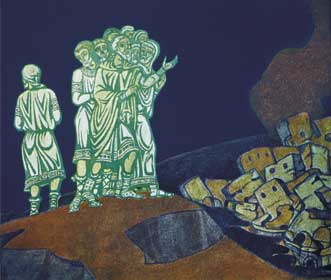 | |
| N. Roerich. Human deeds |
|
The machine and technogenic civilization of the 20th century ceases to need philosophy, true art and religion in the real sense of this word. It substitutes an industry of entertainment for Culture on the basis of which so-called mass culture appears with the purpose of servicing society’s matter instead of nourishing its spirit. It indulges base feelings and instincts of the human body, kills its energetics, interferes with the development of harmony between spirit and matter and impedes any further evolutionary ascent of man. When we say that mankind has reached a dead end, having flooded the planet with machines, having subordinated man to these machines, having caused irreparable damage to the ecology of the planet, and accordingly to man himself, we must understand the reason for all this. This reason is the divergence between Culture and civilization: the belittlement of Culture and putting material civilization on a pedestal. Once, due to a number of specific reasons, the balance of Culture and civilization holding the planet like two wings was disturbed, it shifted and everything went wrong. It did not proceed along the evolutionary current regulated by the Great Cosmic Laws, but along a bumpy and dusty road leading to a dead end threatening energetic catastrophes.
Distortions in the interaction of Culture and civilization, which we are now observing, determined another negative phenomenon. Probably, for the first time in humanity’s history, at the turn of the 20th and 21st centuries, technogenic civilization started to affect Culture, belittling and often reducing to nothing the role assigned to it by cosmic evolution and the history of mankind. It is the influence of technogenic civilization on art that has resulted in some of its trends in the forgetfulness of beauty, in a loss of feeling for beauty itself, and the formation of all kinds of ugly objects. And of course, the most terrible thing is when such creations become a fashion enjoying mass popularity. Machine forms have entered pictorial art, and music has started repeating the primitive rhythms of machinery. Today, we are observing a new process where civilization at large has taken hold of human souls in the full sense of this word and has started destroying Beauty and the subtle energetics of creation; knowledge has been replaced by ignorance based on the insatiable consumption of modern society.
Roerich stated that every phenomenon has its cycles of development, its ups and downs. In the 20th century, Culture and civilization reached a culmination point in their differentiation and separation, and only synthesis can bring the system of “Culture–civilization” to a state corresponding to the main current of cosmic evolution. In the long run, the aim of the evolution in our dense world is drawing spirit and matter closer together, achieving harmony between them at a certain stage, and finally, their synthesis which will result in the creation of spiritualized matter and will raise its energetic level. According to Roerich, this synthesis will change the essence of civilization, will spiritualize it, and will turn Culture and civilization into an integrated phenomenon acting at a higher qualitative level than at the initial stage. “The benevolent synthesis,” Roerich wrote, “will help bring about lofty and healthy conceptions, and it will teach us to absorb and apply all which yesterday seemed to be an abstract absurdity, or inapplicable awkwardness, or simply ridiculous, from the point of view of conventional habits, prejudices and superstitions.”11
Nicholas Roerich was distinguished with a remarkable quality. His philosophically profound thought always resulted in action. When he became aware of the evolutionary role of Culture as a foundation of evolution, he understood that Culture should not only be developed as the basis of cosmic evolution of mankind, but should also be defended. In the 20th century, the situation with Culture was far from ideal. The First and Second World Wars, all kinds of military clashes, revolutions, and disregard of Culture in peacetime, resulted in destructive processes in its space that beyond doubt arrested its development and in a most negative way affected the evolution of humanity in general. Cathedrals, libraries, galleries, and other priceless exemplars of culture were ruined during armed conflicts. Human ignorance destroyed cultural values that had been accumulated for ages, burned unique manuscripts, stifled the thought contained in ancient writings, outlawed and banned works of literature: a storehouse of the most precious energetics. In other words, landmarks on the evolutionary path of mankind, embracing all spheres of life, were eradicated. The 20th century passed from one catastrophe to another and this resulted from a spiritual crisis on Earth. The 21st century has already witnessed global crises the like of which mankind is still unable to cope with. Ignorance and a low level of consciousness undermine the foundations of Culture, while Knowledge and Beauty, quite often negated and ruined, lie in the space of Culture and represent, according to Helena Roerich’s definition, “the crown of cosmic evolution”.
“We deplore the loss of the Louvain library and the irreplaceable loveliness of the Cathedral of Rheims and Ieper,” Nicholas Roerich wrote with anguish in 1930. “We remember the beautiful treasures of private collections which perished during the world’s altercations. We do not, however, wish to inscribe words of enmity above them; let us simply say: Destroyed by human errors, and recreated by human hope. Nevertheless, errors in this or any other form may be repeated and other precious milestones of human achievements can be destroyed.”12 His presentiment came true. The Second World War leveled to the ground priceless monuments of culture, ruined a great number of priceless pieces of art, and destroyed the most ancient sources of spiritual energy. N.Roerich proved to be right not only in his premonition, but also in the global action that he had taken a few years before the Second World War broke out. The Roerich Pact for the protection of cultural treasures in time of war and in peace was famous all over the world. Nicholas Roerich believed that this Pact imposed obligations not only on the states that signed it, but also on society in general. The Roerich Pact had a broad sphere of application and counted to a certain extent on a mass movement for the protection of culture. “We shall not tire of repeating,” he wrote, “that in addition to recognition by governments, active public participation is also needed. Cultural values adorn and elevate all life, from small to great. Therefore active care of them should be exercised by all.”13 Roerich asserted that the principle of public involvement “should lie in the foundation of every common cause.”14 It is hard to overestimate the importance of this idea. Only society as a whole can really do something for culture, because it is society, not those in power, that is its bearer; it is society and not state officials which can really organize the protection of culture. Constituting a space of free creativity, culture itself has social and national roots. Culture is created by society for society.
|
|
||
|
||
