
George Roerich /Yuri Nikolayevich Roerich/
(1902 – 1960)
Yuri Roerich is one of the greatest orientalists, linguists, and encyclopedists of the 20th century, and his name is known in many countries around the world. He spoke fluently more than 30 European and Asian languages and dialects, was a brilliant expert in Eastern culture, religion and philosophy. He also represented that synthetic trend in Oriental Studies in which Russia could justly take pride.
Yuri Roerich was born in the village of Okoulovka of the Novgorod Province, on August 16th, 1902. He spent his childhood and adolescence in Saint Petersburg. From an early age, the boy took interest in history and military science. Helena Roerich wrote in her letters: “The elder son showed love for history and tin soldiers. He had thousands of them. His passion for the art of war has survived until now. Strategy is his pet subject. By the way, this talent is inborn, and he is very proud of his ancestor – field-marshal Mikhail Golenischev-Kutuzov, the hero of the war of 1812”[1].
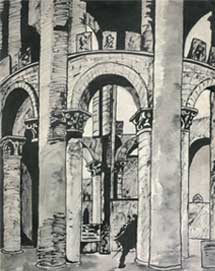 | |
| G. Roerich. In the castle. 1917 – 1918 |
Already at the age of 15, Yuri Roerich was studying Egyptology with the famous scientist-Egiptologist B. Tourayev, as well as the Mongolian language and the history of Mongols with A. Roudnev.
Young Roerich’s paintings and graphics performed during his school years testify to the broadness of his interests and his versatile talents, as well as to his artistic gift.
Having graduated from the Karl May Gymnasium, he entered the Indo-Iranian Department of the London University School for Oriental Languages. His outstanding abilities for languages were so obvious that he was introduced as the best Sanskrit student to the Secretary of State for Indian Affairs who came to visit the University.
In September of 1920, Yuri Roerich together with his parents left for the USA. There he entered Harvard University, in the Indian Philology Department, at the same time he took up Pali and Chinese languages. His purposefulness was striking: at the age of 18 he was already a formed Orientalist having his own subject and his own trend in science.
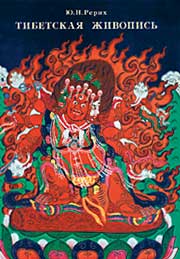 | |
| G. Roerich. Tibetan painting.
ICR publication, 2002 |
After graduating from Harvard University with a Bachelor and Master degrees, Yuri Roerich continued his education in France, in the School for Oriental Languages at the University of Paris. He worked for a year at the Central-Asian, Mongolian and Tibetan Departments of this University, and at the same time studied at the Military Department and Department of Law and Economy. In 1923, Y. Roerich graduated from the University of Paris and received a Master degree in Indian Philology.
At the age of 21, Yuri Roerich had already started an independent scientific research work. Since that moment, all his further scientific activities became permeated by high humanist aspirations.
In 1923, the Roerichs family moved to India. There started the first stage of the Central Asian expedition organized by N. Roerich. In 1924 after a short short-term but a very tight and long distance traveling around India (December of 1923), Yuri Roerich together with his family undertook minor expeditions around Sikkim – a country of snowy giants and ancient monasteries – and Bhutan, a territory in the Eastern Himalayas. The result of these journeys was a brilliant monography – “Tibetan Painting” (Paris, 1925). This scientific study completed by Yuri Roerich at the age of 23 is unique, as no other similar works have ever been written since then. Decades later, the modern reprint of this study, undertaken by the International Center of the Roerichs in 2002, would be highly appreciated by the 14th Dalai-Lama.
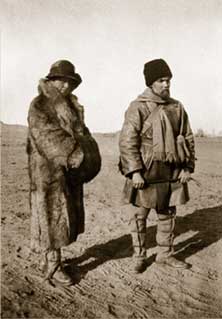 | |
| H. and G. Roerich during the Central-
Asian expedition. 1927 – 1928 |
From 1925 to 1928, Yuri Roerich occupied the main stage of the Central Asian expedition. Yuri Roerich, despite his young age, was entrusted to take care of the expedition’s safety. There, his knowledge of military science proved more than useful. Not only once Yuri Roerich’s tactical skills and personal courage saved the caravan. In addition to this, he acted as a translator, by speaking perfect Mongolian and other Tibetan languages, as well as a number of Central Asian dialects. This allowed him to communicate with the local population and was of inestimable scientific use. It would not be an exaggeration to say that without Yuri Roerich, it would not have been possible to solve many of the tasks that awaited the Central Asian expedition.
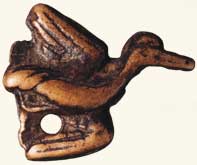 | |
| Little duck. “Beast Style”.
Bronze from the Roerich family collection |
The unique achievements of the expedition were reflected in Y. Roerich’s monographic work “Along the Paths of Central Asia” (London, 1931) which immediately placed the young researcher within the ranks of the scientists-pioneers of Asia.
Yuri Roerich described in his study “The Animal Style Among the Nomads of Northern Tibet” (Prague, 1930) , the discovery during the Central Asian expedition of menhirs, cromlechs and stone graves – an occurrence that became a significant event in scientific world. L. Goumilev wrote: “Yuri Roerich’s study of the “animal style” in Tibet which long ago became a bibliographic rarity, is quoted by all historians of the Scythian and Sarmat art as a composition that made an epoch in science”[2].
|
|
||
|
||