




| printer friendly | |||
|
|||
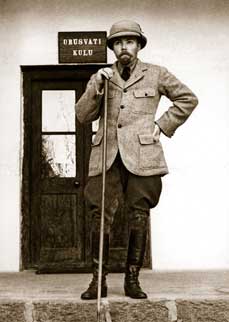 | |
| G. Roerich at the entrance to the
”Urusvati” Institute. 1930s |
Upon the completion of the expedition enormous scientific material that had been collected on route was passed on to the Himalayan Research Institute “Urusvati” founded in July of 1928. L. Shaposhnikova, eminent modern researcher of the Roerich family life and oeuvre, in her study “The Light of the Morning Star” writes that this material “was the first precious seed of that new science of which the Living Ethics wrote and the Teachers standing high on the ladder of cosmic evolution spoke”[3, pp. 79-115]. For more than 10 years, Yuri Roerich was the Institute’s Unchallenged Director.
Defining the Institute goals, he wrote: “Comprehension of the main ways of mankind’s development is a step to understanding one’s own personality. Turning back to the past, we reveal the present for ourselves. <…> A forgotten civilization is concealed in the mountains; it keeps ancient wisdom and culture. It is here that the science which has found itself in a deadlock can find its renovation. Ancient wisdom is the key with which archeologist and naturalist open secrets of the Oriental culture. <…> Again a time is coming when the Oriental knowledge penetrates into our life and subordinates to itself science”[4, p. 200].
In 1934 – 1935, Y. Roerich together with N. Roerich undertook an expedition to Manchuria and Inner Mongolia organized on the initiative of the US Department of Agriculture with the purpose of collection of seeds of drought resistant plants that prevent erosion of soils and the spreading of pests. Besides purely scientific objectives, the expedition also pursued a social and cultural goal – the creation on the territory of Manchuria and, afterwards, of Inner Mongolia, of agricultural cooperatives on the basis of wide public collaboration.
As a distinguished encyclopedic-scientist, Yuri Roerich was elected a member of the Royal AsiaticSociety in London, the Asiatic Society in Bengal, the Paris Geographic Society, the American Archeological and Ethnographic Societies, and many others.
Yuri Roerich spent more than 35 years abroad, lived in India for a long time. Nevertheless, he always remained a true patriot of his Motherland, and never acquired foreign citizenship. When fascist Germany attacked the Soviet Union, Yuri Roerich immediately sent a telegram to the Soviet Embassy in London with a request to recruit him as a volunteer in the Red Army, but received a refusal.
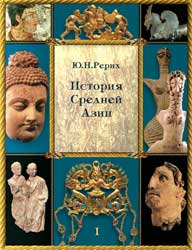 | |
| G. Roerich. History of Middle Asia.
ICR publication, 2002 |
In August of 1957, Y. Roerich returned to Moscow from India. It became possible thanks to N. Khruschev’s personal involvement; he had met Yuri Roerich during his official visit to India. Only after that, Y. Roerich got Soviet citizenship and permission to come back to his Motherland.
In Moscow, Yuri Roerich started working in the Institute of Oriental Studies of the USSR Academy of Science and headed the “Section of Indian Philosophy and History of Religions”. For almost three years spent in the Soviet Union (August 1957 – May 1960), he carried out work of incredible scope, compared to a whole human life. Yuri Roerich revived scientific traditions of the Russian Oriental Studies, created a Russian school of Tibetan Studies, and thanks to him, for the first time in the USSR, Sanskrit started to be taught. Finally, he laid the foundations for a new science – Nomadistic studies. For a short time during his activities in Moscow, Yuri Roerich prepared for publication a Tibetan-Russian-English dictionary in several volumes with parallels in Sanskrit and several articles and scientific studies. On Yuri Roerich’s initiative, works on translation and publication of ancient philosophic and literary manuscripts of the East were resumed. He revived the famous series “Biblioteca Buddhica”, founded by the outstanding Russian Orientalist S. Oldenburg in 1897 and dedicated to Buddhist philosophy, religion and art. Yury Roerich worked as the academic editor for A. Vostrikov’s book “Tibetan Historical Literature” and the fundamental Buddhist treatise “Dhammapada” (a collection of Buddha’s quotations). This literary monument of the ancient Indian philosophic thought became an important stage in the study of Buddhism in this country.
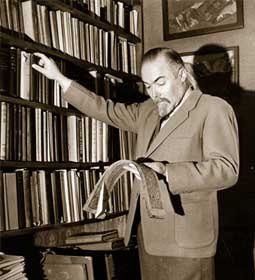 | |
| G. Roerich. Moscow. 1958 – 1960 |
Yuri Roerich’s fundamental scientific study “The History of Middle Asia” that remained in handwritten form and on which he had worked for many years should be especially noted. He started working on it in India and planned to complete it – but did not complete – in his Motherland. Using the term “Middle Asia”, Yuri Roerich meant the vast territory from the Caucasus to Great Khingan and from the Himalayas to Altai. This study is a cultural and historical review of the most important state and cultural formations in the huge territory of Eurasia. Presently, the International Center of the Roerichs released the 1st volume of this unique study. Taking into account that the USSR autorities had been for a long time trying to form a distorted impression of the Roerich family in the public mind, Yuri Roerich’s repatriation and acquisition of Soviet citizenship would be a courageous and selfless step.
It is Yuri Roerich to whom we are obliged for an opportunity to get widely acquainted with the multi-faceted creative heritage of his parents – Nicholas and Helena Roerich. His parents’ long cherished dream to come back to their Motherland was not realized during their life time. Their elder son, Yuri Roerich, who returned their good name and great heritage to the Soviet Union, nevertheless, realized it. He brought to Motherland part of his parents’ legacy: more than 500 paintings by his father, a huge library and valuable items.
Thanks to Y. Roerich’s direct participation, not only bans on everything associated with the Roerichs were lifted, but also multiple myths on their life and creative work fell to pieces. Thanks to Yuri Roerich, people around him learnt about the essence and the main concept of the Living Ethics Teaching or Agni Yoga. It was Y. Roerich who started the Roerich cultural movement in the USSR.
Due to Yuri Roerich’s participation and support, the first exhibitions of Nicholas Roerich paintings were organized: first in Moscow (April of 1958), and then in Leningrad, Riga, Kiev, Tbilisi, and other cities.
For the first time, Y. Roerich managed at the governmental level to raise the question of establishing Nicholas Roerichg Museum in the country. For this purpose, he passed on as a gift to the Russian Museum about 350 paintings of his father, on condition that they’d be permanently displayed; 60 canvases were given to the Novosibirsk Art Gallery. Unfortunately, while Yuri Roerich was alive, his dream was not to come true. The state did not establish a permanent display of Nicholas Roerich’s paintings in the Russian Museum. To this very day, most of those canvases have not been on open display for spectators and still remain in storage, collecting dust. As a man, a scientist and a citizen of his country, Yuri Roerich was an outstanding personality. According to Svetoslav Roerich, “Yuri Roerich is the image of a true, inspired scientist and thinker, a man of the highest spiritual harmony. He was well aware that the highest achievement of man is the self-improvement of his personality, and that only due to constant work on himself and development of his qualities a man, striving for a more perfect life, could comprehensively enrich his occupation and raise it above the level of routine”[5, p. 8].
|
|
||
|
||
