




| printer friendly | |||
|
|||
|
|
|
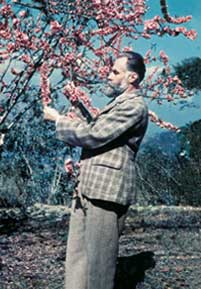
S. Roerich in the upper reach of the Kullu valley |
From 1931 onwards Svetoslav Roerich lived permanently in India, and actively participated in its public and cultural life. He dearly loved that country and it became his second Motherland. In many of his wonderful canvases, Svetoslav Roerich celebrated India’s unique beauty, diversity of cultural traditions and subtleness of spiritual achievements. That is why the honor to call Svetoslav Roerich its national pride befalls not only Russia alone, but on India as well.
After 1947, Svetoslav Roerich conducted a lot of work related to the signing of the Roerich Pact by the Indian Government. Svetoslav Roerich wrote to one of the Indian leaders H. Kabir: “I am happy to note that the attitude of the Indian Government towards the aims we keep in mind is sympathetic, and it approves of the Roerich Pact <…> I now wish so strongly that precisely this country and at this time becomes an active fighter for the cultural principles contained in this Pact <…>” [4, p.325-326]. Due to Svetoslav Roerich’s efforts, in August 1948 India approved this international treaty. During the years that followed, Svetoslav Roerich actively participated in the work on the preservation and protection from destruction of the ancient Indian cultural monuments; he organized committees, and secured the implementation of concrete measures in this direction by the Governments of Indian States.
In July of 1941, after Germany attacked the Soviet Union, Svetoslav Roerich sent a telegram to the USSR Ambassador in London, I. Maisky, about his decision to join the Red Army, but he received a refusal. Nevertheless, during the years of the Second World War, Svetoslav Roerich transferred the funds from his paintings’ and exhibitions’ sales to the USSR Red Cross.
|
|
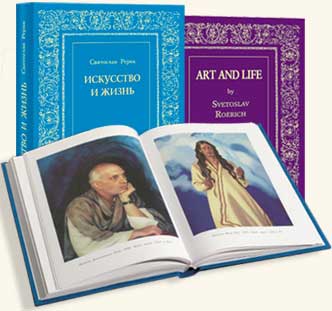
| S. Roerich. “Art and Life”. ICR publication, 2004 |
Svetoslav Roerich took active part in the work of the Himalayan Research Institute “Urusvati.” While he was in charge of the work of the Natural Sciences Department, he carried out unique researches in various fields of the natural sciences. The rare gift of spiritual synthesis that he possessed contributed to this end. At the basis of Svetoslav Roerich’s natural scientific interests was his deep philosophic understanding of nature as one whole that is inalienably connected with the most important cosmic laws. The scope of his scientific interests is striking: ornithology, botany, mineralogy, Tibetan pharmacopoeia, chemistry and its alchemical sources, astrology, comparative religious studies and philosophy, art studies, cultural studies. Such versatile scientific activity of Svetoslav Roerich undoubtedly testifies to his belonging to the pleiad of major natural scientists.
All Svetoslav Roerich’s artistic and literary creative work, as well as his scientific, pedagogical, and public activities are inseparably connected with the ideas of the Living Ethics. If we were to say that Svetoslav Roerich was just its follower we would oversimplify his role. He was not only the follower of this philosophic system, but a profound thinker, who developed its most important propositions and ideas.
Many of Svetoslav Roerich’s philosophical reflections are dedicated to the great role of art in the creation of a human being that is striving for higher levels of perfection, loftiness of thought and virtue. These thoughts of Roerich are reflected not only in his essays and diaries, but also within the entirety of the painter’s creative and artistic work.
"<...> the truth is in Beauty”, one of the Living Ethics books says. “Cosmos bases evolution on this formula. The Cosmos directs the world to the mastering of Beauty” [5, 178]. Beauty, its essence and its role in the evolutionary development of mankind, as well as the energetic processes related to it constituted the foundation of Svetoslav Roerich’s philosophic views. He himself, as an artist and thinker, was attracted first of all to the phenomena of Beauty created by human beings. Svetoslav Roerich said: “Great works of art are storages of enormous energies, which can activate and change millions of contemplators, and influence numberless generations through the message of beauty emanating from them. <…> Inexpressible aura of glory is irradiated by a great work of art. This is an emanation of concealed vibrations fixed in the structure of a great creation. The magic of feelings, thoughts, and strong desires of the great masters is captured in the works of art, it is irradiated on the spectator, and awakens in him/her similar emotional response, besides the purely energetic and spiritual understanding of what is spoken about. We respond to more perfect combinations and call them beautiful. <…> This is the extraordinary power of art, its hidden strength, always present and active in a great work of art”[6, p.61-64].
Svetoslav Roerich was convinced that Beauty could not be created without a higher ideal. The destruction of such an ideal – spiritual or aesthetic – would result in the disfigurement of life and in the loss of its evolutionary pivot.
All his life he remained interested in the problems connected with the upbringing of more perfect human being. Therefore the painter took active part in the work of the children’s school in Bangalore (India) established in 1962 on the basis of the teachings of the Indian philosopher Aurobindo Ghosh. Children were accepted in that school from the age of three. The school’s pedagogical conception was based on the moral and ethical upbringing of children by way of specially elaborated methods. From a very early age these children were acquainted with the ideas of major philosophers, including Helena Roerich and Nicholas Roerich; considerable attention was paid to their artistic education. The annual children’s drawing competitions contributed to this end.
Svetoslav Roerich noted: “In our pedagogical work in Bangalore, we are trying from the very beginning to lead the new generation along the paths of ascent, to give them thoughts and ideas of great philosophers from the very early years. <…> The education we give should bring us the result of strong persons that complete and leave the school, persons that can resist evil and imperfection” [7, p.89-90]. From 1977 onwards Svetoslav Roerich supported the school financially.
|
|
|
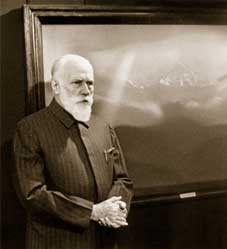
S. Roerich near his painting “Kanchenjunga. Secret Hour”. Moscow. October 23, 1984. |
Svetoslav Roerich is well known as the founder and Honorary President of the cultural and educational Center for Arts “Chitrakala Parishad” that was established in Bangalore in 1972 and later became the artistic department of the local university.
For outstanding achievements in the field of culture, and for his contribution to the cause of peace, Svetoslav Roerich was honored with governmental awards from various countries, including the highest civil order of India “Padma Bhushan”, the Soviet order “Friendship of Peoples” and the order “Madar Cavalryman” established by the State Council of Bulgaria. Svetoslav Roerich was also a winner of the Jawaharlal Nehru’s International Award; he was holder of the Bulgarian Order of Kirill and Methody as well as of the title of Honorary Doctor of the Velikotyrnovo University of Bulgaria. The great painter was also Academician of the Indian Academy of Fine Arts and Honorary Member of the USSR Academy of Arts. However, Svetoslav Roerich considered the award established by the Nicholas Roerich Museum in New York to be the most outstanding award in his life, since the award diploma had been signed by Nicholas Roerich himself.
The first exhibition of Svetoslav Roerich’s paintings was opened in his Motherland on May 11th, 1960, at the A. Pushkin State Museum of Fine Arts. A month later, the artist’s paintings could be seen by the visitors of the Leningrad Hermitage. Since the beginning of the 1970s, exhibitions of his paintings were regularly organized in the cities of the Soviet Union.
In 1989 on Svetoslav Roerich’s initiative the Soviet Roerichs Foundation was established in Moscow. In March 1990, acting in accordance with his parents’ will, he passed onto the Soviet Roerichs Foundation the priceless heritage of his family [*] – paintings, objects of fine arts as well as applied arts, archival material, a library, and personal items. In 1991, on the initiative of Svetoslav Roerich and due to the collapse of the Soviet Union, there was established the International Centre of the Roerichs on the basis of the heritage transferred earlier to the Soviet Roerichs Foundation. Svetoslav Roerich by way of his Power of Attorney of 27.04.1992 and later on the Assignment Deed of 22.10.1992 [**] transferred to the International Centre of the Roerichs his heritage. It is this heritage that constituted the foundation of the permanent exposition of the non-governmental Museum named after Nicholas Roerich of the International Centre of the Roerichs (ICR). Its activities follow the principles laid down by Svetoslav Roerich who is ICR’s Honorary President up to the present day.
Svetoslav Roerich passed away on January 30, 1993.
* Svetoslav Roerich. Testamentary disposition «Archives and Heritage of Roerich for the Soviet Roerichs Foundation»
Annexes to the Testamentary disposition of Svetoslav Roerich:
- Annexure I – Archives of Roerichs
- Annexure II – Books of Roerichs
- Annexure III – List of paintings of N. Roerich
- Annexure IV – Paintings of Svetoslav Roerich (p.1, p.2, p.3, p.4, p.5, p.6)
- Annexure V – Paintings of Prof. Nicholas Roerich (p.7, p.8, p.9, p.10)
- Annexure VI – Personal belongings of N.K. Roerich, H. I. Roerich, G.N. Roerich
** Assignment Deed in favour of ICR, 1992
|
|
||
|
||
