



 |
| printer friendly | |||
|
|||
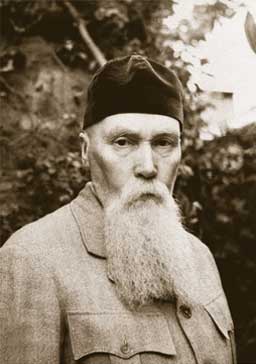
Nicholas (Nikolai Konstantinovich) Roerich (1874 – 1947)
Nicholas Roerich belongs to the galaxy of outstanding figures of Russian and world culture. Painter, scientist, traveler, public figure, writer, thinker – his versatile gift can probably only be compared with the titans of the Renaissance epoch. Nicholas Roerich’s creative heritage is enormous – more than seven thousand paintings scattered all over the world, numberless literary works – books, essays, articles, diaries…
Nicholas Roerich was born in a family of the famous notary Konstantin Fedorovich Roerich in Saint-Petersburg, on October 9th, 1874.
From his childhood, he was attracted to painting, archeology, history, and, most of all, to the rich heritage of the East. All this merged together produced afterwards an amazing result, and made Nicholas Roerich’s creative work bright and unique.
Upon finishing the Karl May Gymnasium in 1893, Nicholas Roerich simultaneously enrolled in the Saint-Petersburg University Faculty of Law (he graduated from it in 1898) and the Imperial Academy of Arts. From 1895, he studied in the studio of the famous Arkhip Kuinji. At that time, he closely communicated with well-known cultural figures of those days – V. Stassov, I. Repin, N. Rimsky-Korsakov, D. Grigorovich, S. Diagilev.
In 1897, N. Roerich graduated from the Saint-Petersburg Academy of Arts, and his final diploma painting, “Messenger”, was acquired by the famous collector of Russian pieces of art, P. Tretiakov.
At the age of 24, Nicholas Roerich had already become an assistant to the Director of the Emperor’s Art Encouragement Society Museum(Director of the Museum under the Imperial Society for the Encouragement of the Arts ) and, at the same time, editor assistant of the art magazine “Mir Iskusstva” (“World of the Art”).
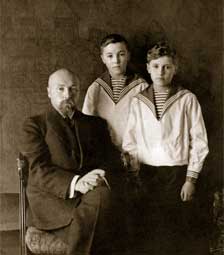 | |
| N. Roerich with his sons. 1914 – 1915 |
In his books, N. Roerich called Helena Roerich “inspirer” and “friendess”. She was the first to whom he showed each of his new paintings and he highly appreciated her artistic intuition as well as her subtle taste. Many of the artist’s canvases were created on the basis of Helena’s images, thoughts, and creative insights. But her ideas were not only reflected in his paintings – it is hard to mention even one sphere in N. Roerich’s activities where these were not present. Behind each one of Nicholas Roerich’s creative acts, behind his verses and fairy-tales, behind his paintings and journeys – there will always be Helena Roerich. According to S. Roerich “collaboration of Nicholas and Helena Roerich was a most rare combination of full consonance on all planes. Supplementing each other, they seemed to merge in a richest harmony of intellectual and spiritual expression”[1, p. 49].
In 1903 – 1904, N. Roerich together with his wife made a trip to the old cities of Russia. They visited more than 40 cities famous for their ancient monuments. The aim of this “trip through antiquities” was the study of the roots of the Russian culture. The trip’s result was not only a wide series of the artist’s paintings, but also N. Roerich’s first articles. In them, he was one of the first to raise the issues concerning the great artistic value of old Russian icon-painting and architecture.
The artist’s paintings on religious subjects in the form of frescoes and mosaic sketches for Russian churches also refer to the same period.
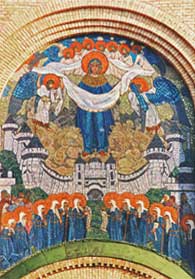 | |
| N. Roerich. The Protecting Veil of the
Holy Mother of God. 1906 – 1907. Mosaics are performed by V. Frolov. Church of the Protecting Veil of the Holy Mother of God. Village of Parkhomovka, the Kiev Region |
Nicholas Roerich’s multi-faceted talent brightly manifested itself in his works for theatre stagings. During S. Diagilev’s famous “Russian Seasons”, N. Roerich designed the staging of “Polovtsian Dances” from Borodin’s “Prince Igor”, Rimsky-Korsakov’s “Pskovityanka”(Pskovian woman), and the ballet staging of the “Sacred Spring” to Stravinsky’s music. Thanks to Helena Roerich, Nicholas Roerich became acquainted with the works of outstanding Indian thinkers – Ramakrishna and Vivekananda – they also became familiar with R. Tagor’s literary pieces and they studied together the Upanishads.
An acquaintance with the Oriental philosophical thought was reflected in N. Roerich’s creative work. While the core subjects of the artist’s earlier paintings was ancient pagan Russia with its colorful images of the folk epos and primeval splendor of the uncorrupted natural element (“They Build a City”, “Idols”, “Guests from Overseas”, etc.), starting already from the middle of the first decade of the 20th century, the theme of India and the East appears increasingly more frequently on his canvases and in literary pieces.
In 1916, due to a severe illness of the lungs, in accordance with his doctors’ insistent advice, N. Roerich together with his family moved to Finland (Serdobol), to the Ladoga Lake coast. Proximity to Petrograd (Saint Peters-burg) allowed him to go from time to time to the city on the Neva river and deal with the Art Encouragement Society School affairs(with the affairs of the School under the Art Encouragement Society). However, after the revolutionary events of 1917, Finland closed its borders with Russia, and N. Roerich with his family found himself cut off from his Motherland.
In 1919, having received an invitation from Sweden, Nicholas Roerich traveled with exhibitions around the Scandinavian countries, and in the fall of the same year, he accepted S. Diagilev’s invitation to work as the designer for Russian operas to the music of M. Mussorgsky and A. Borodin in London, and together with his family went to England.
|
|
||
|
||

